Generalization of AI-Generated Image Detectors — A Face-Centric Study
Authors: Thomas, Elizabeth, Fengchen
Focus: Open-set generalization of AI-generated image detection
Overview
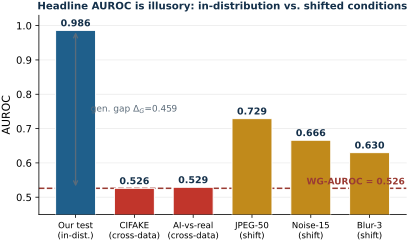
Headline accuracy numbers for AI-image detectors are often illusory: a model that scores near-perfect on its own test set can degrade sharply under cross-data and corruption shifts. This study measures that gap and shows that narrowing the domain to human faces restores strong, transferable detection.
Aligned Real / Synthetic Pipeline
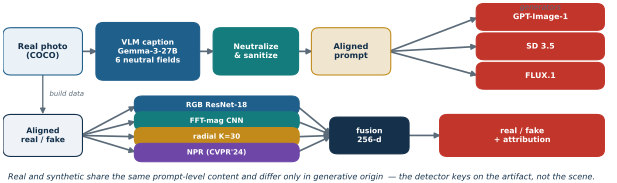
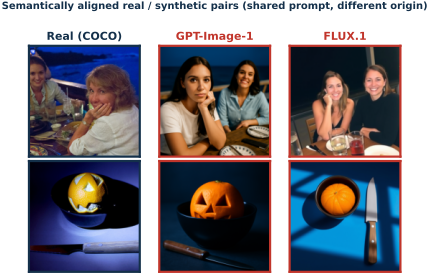
We start from real COCO photos, caption them with a VLM, neutralize the prompts, then regenerate semantically matched synthetic images across multiple generators (GPT-Image-1, SD 3.5, FLUX.1). Real and synthetic share the same content and differ only in generative origin.
The Generalization Gap
A generic detector reaches 0.986 AUROC in-distribution but falls to a worst-group 0.526 under cross-data and corruption shifts (JPEG, noise, blur) — close to random.
Faces Generalize
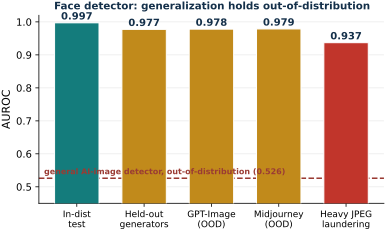
Restricting the task to faces, the detector holds up out-of-distribution: 0.997 in-distribution and 0.937–0.979 across held-out generators (GPT-Image, Midjourney) and heavy JPEG laundering.
Key Findings
- Single-dataset accuracy overstates real-world robustness; open-set evaluation is essential.
- Generic detectors collapse under unseen generators and common corruptions.
- A face-focused detector retains strong, transferable performance, pointing to domain specialization as a practical path to reliable AI-image forensics.
Publication
This work is presented at SIGGRAPH 2026 (Poster).
Back to Research Portfolio